Showing posts with label Becca. Show all posts

Wednesday, 2 November 2011

Music/ Soundtrack

Considering that the main theme of our film opening will be pirates, I looked at various other pirate themed films, and the music or soundtracks they used.

http://www.youtube.com/watch?v=EWPJrSSXtww - Pirates of the Caribbean

http://www.youtube.com/watch?v=PlgEH2IAKHI - Fox's Peter Pan and the Pirates

http://www.youtube.com/watch?v=8WWdOjxoQro&feature=related - Muppet Treasure Island


Children's Film Sequences

In order to gain inspiration and ideas for our film sequence, we looked at various children's film openings and made notes.

Macho Libre
- chirpy music (cheerful)
- comedy elements
- bright colours
- combining two titles
- the face is not shown - just a hand stealing things

My Neighbour Totoro
- simple drawings
- catchy music
- animated figures, lots of movement

Bedtime Stories
- simple, cheerful dialogue
- happy music
- bright colours

Monsters Inc
- simple shapes, moving to the music
- the title sequence gives clues to the themes and plot of the film, e.g the doors, the colour blue, the monsters
- cheerful, upbeat music
- bright colours
- cartoon/ animation

Lemony Snickett
- orchestral music
- dialogue kept clear and simple
- introducing characters through various objects connected to them; Violet, inventions, Klaus, books, Sunny, chewed scrabble pieces

Nightmare Before Christmas
- catchy music, easy to remember the tune
- builds up an atmosphere
- animation

The information I have gathered from these openings indicates that our children's film opening should be relatively simple; the dialogue should be clear and easy to understand and no darker themes or distressing issues should be referenced. Lots of bright colours and catchy, cheerful music should be used to create a happy atmosphere. Comedy elements could also be used to build up atmosphere.

Thursday, 20 October 2011

"BBFC" Class Session


  • In our BBFC session, we researched film classifications and then guessed the classifications of some sequences from children's films.
  • As we our making a children's film opening, the main classifications that we focused on were U and PG.
  • U stands for Universal and PG stands for Parental Guidance.
  • In a U film should be suitable for any child (or person) aged 4 years or over. There should be no references to drugs or discrimination unless clearly disapproved of. Any scary sequences should be mild, with a reassuring outcome and there should be no dangerous behaviour which children might copy. If bad language is used, it should be infrequent and mild, occasional natural nudity is permitted, as is mild sexual behaviour (e.g. kissing) and slight references (e.g. "making love"). Any violence shown or referenced should be mild.
  • Children of any age may watch a PG film, as the scenes should not disturb a child aged eight or older, but parents are advised to consider whether some scenes may upset particular children. Discriminatory behaviour is rarely acceptable unless clearly disapproved of, or shown in an educational or historical context. References can be made to illegal drug use, but must carry a suitable anti-drugs message. Horror or frightening sequences must not be prolonged (although some exceptions may be made in a fantasy setting), and there must not be any behaviour which children could copy; weapons (especially those that are easily accessible) must not be glamourised. Mild bad language only, natural nudity permitted (with no sexual content) and sexual activity may be implied (through innuendo etc.) but must be infrequent. Serious issues (e.g. domestic violence) may be featured, but must be clearly disapproved of. Moderate violence may be featured in context (e.g historical, comedic or in a fantasy setting).
  • Once we had researched the different classifications, we were shown four different sequences and asked to predict the classification given to each film.
  • The first one we saw was a clip from Harry Potter and the Philosophers Stone. I guessed a PG rating for this film, as there was a scary sequence in the woods that I did not think would have featured in a U film. I was correct.
  • The next film we saw was Up. I wasn't entirely sure what the rating for this film would be. There were a few references in it that made me lean towards a PG, but not enough references of explicit content to distinguish it from a U. In fact, Up has a rating of U.
  • The next clip was from Watership Down. There were quite a few frightening scenes (including rabbits being savaged to death) so I thought that the rating must at least be a PG. I was therefore quite surprised when it was revealed that the rating was in fact a U. I think there were definitely some scenes in there which could scare small children if not under parental supervision.
  • The least scene we watched was from Home Alone. I was confident that this was a PG, as there were some sexual and violent references that would definitely not appear in a U film. I was correct.
  • We need to know about U and PG classifications as they are the standard classifications for a children's film. We also need to know about them so that we know what we can and cannot include in our own film openings.

Wednesday, 19 October 2011

"Back to the Future" Storyboarding Task


  •         In this session we learnt about storyboarding and what it is.
  •          A storyboard is a series of illustrations or images displayed in sequence, with the specific purpose of helping to pre-visualise a motion picture/ animation etc.
  •          Most storyboards are often annotated in order to convey the exact meaning of the shot being depicted.
  •          A storyboard will typically include shot types; whether it is an extreme close up, long shot or mid-shot.
  •          It should also include details within the shot, e.g. movement or direction. For example, if a character is moving, it should be clearly shown where the character is going. The same applies for any moving objects.
  •          Camera movement should also be noted – the direction, speed, a pan or a tilt.
  •          Cuts between scenes should be indicated, when they happen, and shown where they are cutting to and from.
  •          Sound also plays an important part – a soundtrack, dialogue, diegetic or non-diegetic, etc.
  •          We then created our own storyboards to the opening sequence of “Back to the Future”. Essentially, this is doing things in reverse – normally the storyboard is created before the movie is made.
  •          The storyboarding exercise was to help us with our own coursework; as we need to include a storyboard, the task helped us to learn how to plan out and annotate our own. We also learnt about what features we could use to improve it.
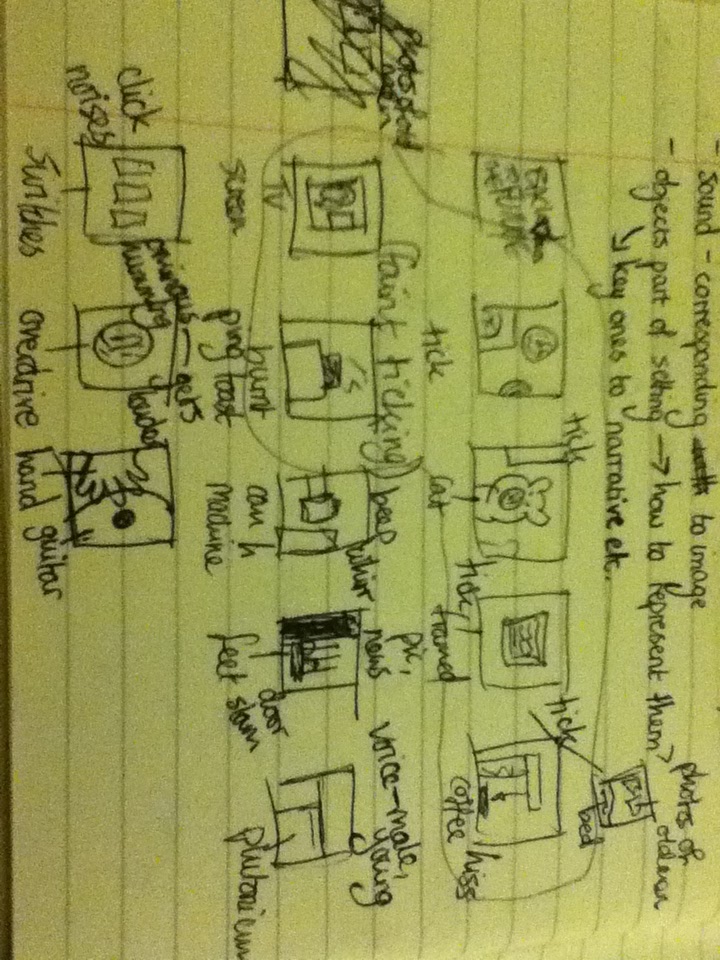
  •          I have also included an image from some of my notes from the session.


"Wallace and Gromit: The Curse of the Were-Rabbit" Analysis

  • The film starts by showing a framed photograph on brightly coloured wallpaper, with chirpy music playing (Non-diagetic). This immediately sets a cheerful mood for the beginning of the film. It also slightly hints at being a children's film, as children's films generally involve bright colours and happy music.
  • The use of plasticine to create the figures also hints that it might be aimed at a younger audience, as most animated and cartoon films are children's films.
  • A comedy theme is also referenced through the actions displayed by the characters in the photos (e.g Gromit with his hand on his hips, Wallace with some cheese and hiding it in his mouth, Gromit with his hand over his face).
  • This comedy theme is carried through into the photos where Wallace and Gromit fall out and make up; this also hints that it might be a children's film as it gives a positive mood.
  • Suddenly,  the happy mood is shattered, as a shadow crosses the wall; the music becomes creepy and dramatic. This builds tension and changes the mood. The camera pans out of the window, showing the night sky and the moon. As the camera pans upwards, the music changes again, becoming more eerie and orchestral, building the tension.
  • The title appears, and the font indicates that there will be a horror element to the film; this gives a clue as to the genre, and later events in the film. This is then reinforced by the title growing fur and ears; this hints to the reader as to what happens later. Also a possible subtle comedy undertone with the ears.
  • The camera then fades into a puddle with a foot in it; this introduces the character of the policeman.
  • The background of the night sky and the fact that he is walking down a street by himself adds to the eerie atmosphere.
  • There is the sound of a glass window smashing; this helps create a tense, spooky atmosphere. The shadow flitting past the wall keeps the tension building and the viewer interested.
  • The comedy theme is again referenced, subtly, by an advert on the wall of a building for "VEG B BIG".
  • The canera then cuts to the creature's perspective (presumably the creature who smashed the window and to whom the shadow belongs), and there are snuffling noises, which keep building the tension.
  • A gate is shown, and the latch moves. The gate swings open, but the viewer still cannot see the creature, which keeps the spooky atmosphere and the hint of the horror genre.
 
© 2009 12Q2-15 CHILDRENS FILM 2011. All Rights Reserved | Powered by Blogger
Design by psdvibe | Bloggerized By LawnyDesignz